
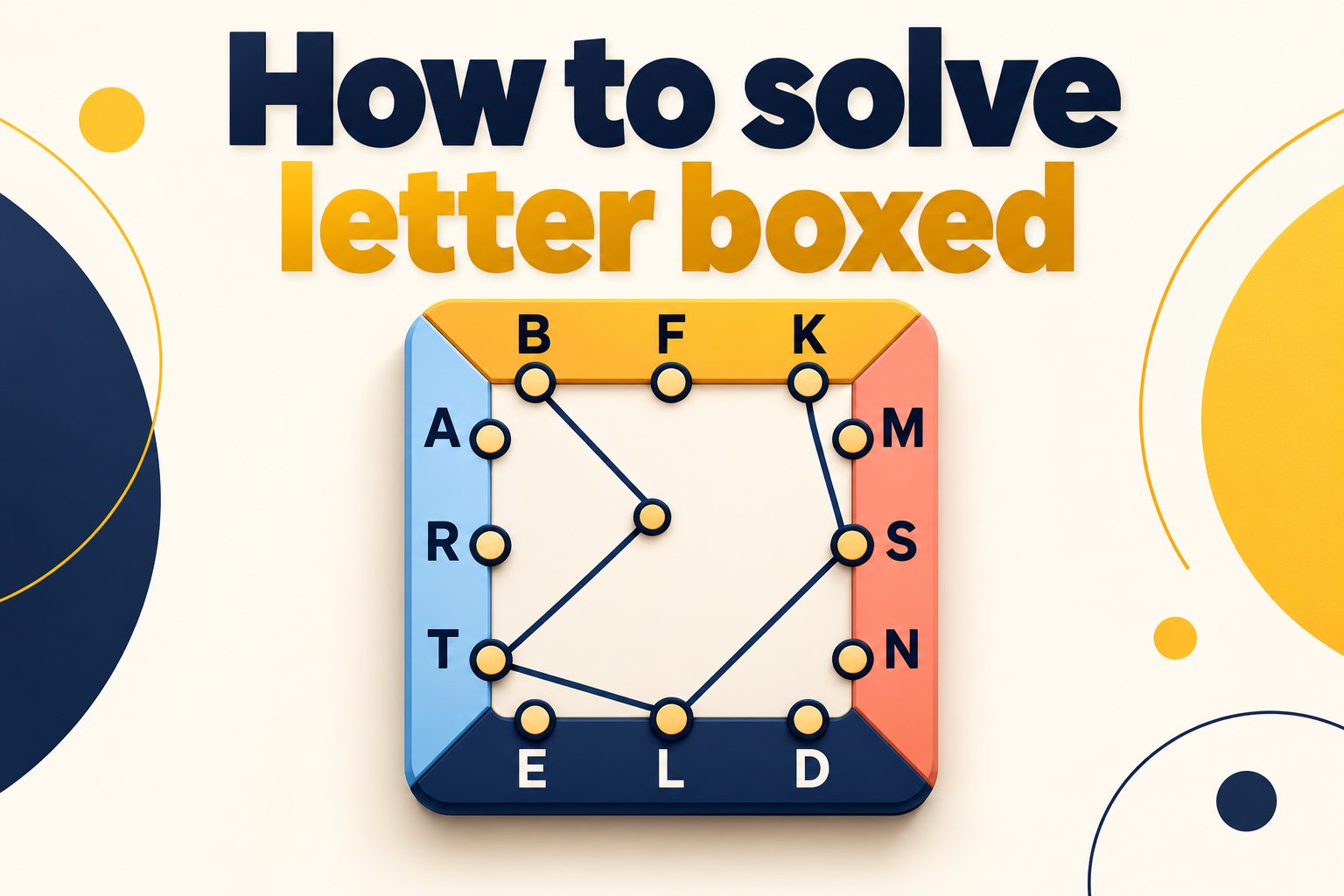
Learning how to solve Letter Boxed can turn a confusing letter puzzle into a satisfying daily habit. The game asks you to connect letters around a square, build valid words, and use every letter while following one important rule: consecutive letters in a word cannot come from the same side.
At first, it is tempting to hunt for one long word immediately. A better approach is to read the board as a network of possible jumps. Each word changes the starting point for the next one, so planning the handoff letter matters as much as finding a valid word.
This guide explains the rules, a practical solving method, useful word patterns, common mistakes, and ways to improve. Whether you want to finish the puzzle reliably or reduce your solution to only two words, the goal is to make each move purposeful.
Letter Boxed is a word puzzle played on a square with three letters on each side. You create words by moving from one side of the square to another for every consecutive letter. A word may revisit letters, but it may not use two neighboring letters from the same side.
Each new word must begin with the final letter of the previous word. That chaining rule means a solution is not simply a collection of words. It is a sequence in which every ending creates a useful next beginning.
To complete the puzzle, your chain must use all twelve displayed letters at least once. You do not need to use every letter exactly once, and repeating helpful letters is often necessary.
The puzzle rewards vocabulary, but strategy is equally important. Short connector words can be valuable when they move you from an awkward final letter to a flexible starting letter for a larger word.
A strong solution usually combines coverage and control. You want early words that collect difficult letters, middle words that expand coverage, and a final word that fills any remaining gaps without breaking the chain.
How Do You Solve Letter Boxed Efficiently
Map The Four Sides First
Before entering a word, write down or mentally group the letters by side. This prevents a common error: seeing a familiar word but missing that two consecutive letters sit on the same edge. A quick side map also reveals which letters are likely to be hard to reach and should be used early.
Look For Flexible Starting Letters
Begin with letters that can start many common words, especially vowels and frequent consonants such as S, R, T, C, and P. A flexible opening gives you more options after the word ends. Avoid committing to a rare ending letter unless you already see a realistic continuation.
Build Alternating Letter Paths
Test words as paths, not only as spellings. For every pair of letters, check that the second letter is on a different side from the first. Words that bounce among three or four sides are especially useful because they usually add coverage without creating illegal same-side transitions.
Track Used Letters As You Go
Keep a simple mental checklist of letters already used and letters still missing. Do not focus only on word length. A six-letter word that covers four new letters can be much stronger than a ten-letter word that repeats letters you already handled.
Plan The Last Letter Carefully
The final letter of a word becomes the first letter of the next word, so treat it as a handoff. Before submitting a promising word, ask what words can start with its final letter. Endings such as A, E, R, S, and T tend to leave more routes open than unusual consonants.
Use Connector Words When Needed
A short word is not wasted if it repairs the chain. For example, a three- or four-letter connector can shift an awkward starting letter into a more useful one while also collecting a missing board letter. Think of these words as bridges rather than failures to find a long answer.
Review Before Finalizing
When all letters appear covered, reread the full chain from start to finish. Confirm that every word begins with the previous word’s final letter and every adjacent pair changes sides. This final pass catches most accidental errors and helps you spot an opportunity to shorten the solution.
What Makes A Letter Boxed Word Useful
1. Coverage matters because a useful word introduces letters that have not yet appeared in your chain.
2. Side movement matters because a valid-looking word fails if any two consecutive letters come from the same side.
3. Ending value matters because the next word must start with the last letter you just used.
4. Length matters less than efficiency; a shorter word can be better when it solves a coverage or handoff problem.
5. Rare letters deserve attention early because leaving them until the end often creates a difficult final search.
Key Habits For Better Letter Boxed Results
- Scan For Vowels: Locate the vowels first, since they often create the alternating patterns needed to form longer valid words.
- Notice Rare Endings: Be cautious with endings that few ordinary words can follow, especially if several letters remain unused.
- Try Word Families: If one word almost works, test related forms such as plural, past tense, or another common suffix when the path remains legal.
- Use A Scratch List: Keep possible words and their ending letters in a small list so promising options are not lost while you explore.
- Favor New Coverage: Choose the candidate that uses more missing letters when two words leave similarly workable endings.
- Restart Without Frustration: If a chain traps you, restart early; a fresh opening is often faster than forcing several weak repair words.
Which Letter Boxed Mistakes Should You Avoid
Chasing Only Long Words
Long words feel impressive, but they can produce poor chains when they repeat common letters or end on an unusable character. Judge a candidate by coverage, validity, and its next starting letter. A compact chain of practical words usually beats an elegant word that leaves no follow-up.
Ignoring The Same-Side Rule
Many failed attempts happen because the solver recognizes a dictionary word and enters it too quickly. Slow down at each letter pair and trace the sides. This small habit protects you from building an entire plan around a word that the board will reject.
Saving Difficult Letters For Last
Letters such as J, K, V, W, or Y can be awkward depending on their positions. If you postpone them, your final word may need to satisfy too many conditions at once. Include difficult letters in an early or middle word whenever a natural path appears.
Forgetting The Chain Ending
A word is not useful merely because it is valid. Its final character controls the next turn, so submitting without considering that ending can close every obvious route. Always identify at least one possible next word before you commit to a candidate.
Repeating Covered Letters Too Much
Repeated letters are allowed, but excessive repetition makes the chain longer and hides the actual problem: uncollected letters. After each word, check what changed. If a new candidate adds little coverage, reserve it only for a necessary connection or a clearly planned finish.
Rejecting Common Inflections Too Quickly
Solvers sometimes overlook ordinary plurals, verb forms, and familiar derived words that the puzzle accepts. When a base word nearly fits, test a reasonable inflection while checking the side transitions. This expands your choices without relying on obscure vocabulary.
Stopping At The First Complete Chain
Finishing is the first goal, but a completed chain can often be improved. Review it for two consecutive words that could be replaced by one longer valid word, or for a connector that can be removed. This is how you gradually learn to find shorter solutions.
The most reliable way to solve Letter Boxed is to combine word knowledge with route planning. Map the sides, watch every transition, use missing letters early, and protect the final letter of each word.
Do not measure progress only by word length. Useful coverage and a workable handoff create stronger chains than a single impressive word.
With practice, the board becomes easier to read as a pattern of routes rather than a group of separate letters. That shift makes both finishing and optimizing the puzzle much more manageable.
FAQs About Letter Boxed
What Is The Main Rule In Letter Boxed?
The main rule is that two consecutive letters in a word cannot come from the same side of the square. In addition, each new word must begin with the final letter of the prior word. Your completed chain must use every board letter at least once.
Do Letters Need To Be Used Only Once?
No. You may reuse letters as often as needed. The objective is coverage, not using each letter exactly once. Repetition is often helpful when it creates a valid path or allows one word to connect naturally to the next word.
How Many Words Should A Solution Use?
There is no fixed number of words required to finish a Letter Boxed puzzle. A practical solution may use several words, while an optimized solution may use only two. Start by completing the board, then try to reduce the chain if you enjoy the extra challenge.
Why Does My Valid Word Get Rejected?
The most likely reason is that two neighboring letters in the word are located on the same side of the square. Trace the word one pair at a time. It may also fail because it does not begin with the previous word’s final letter.
Should I Start With The Longest Word I Can Find?
Not necessarily. A long word is helpful only if it follows the side rule, adds missing letters, and ends on a letter that can start another useful word. A shorter opening with a flexible ending often creates a much easier route to completion.
How Can I Get Better At Two Word Solutions?
First, become consistent at solving normally. Then look for a long first word that covers many letters and ends with a letter that begins another long word covering the rest. Track repeated letters less closely than the missing letters each word can supply.