
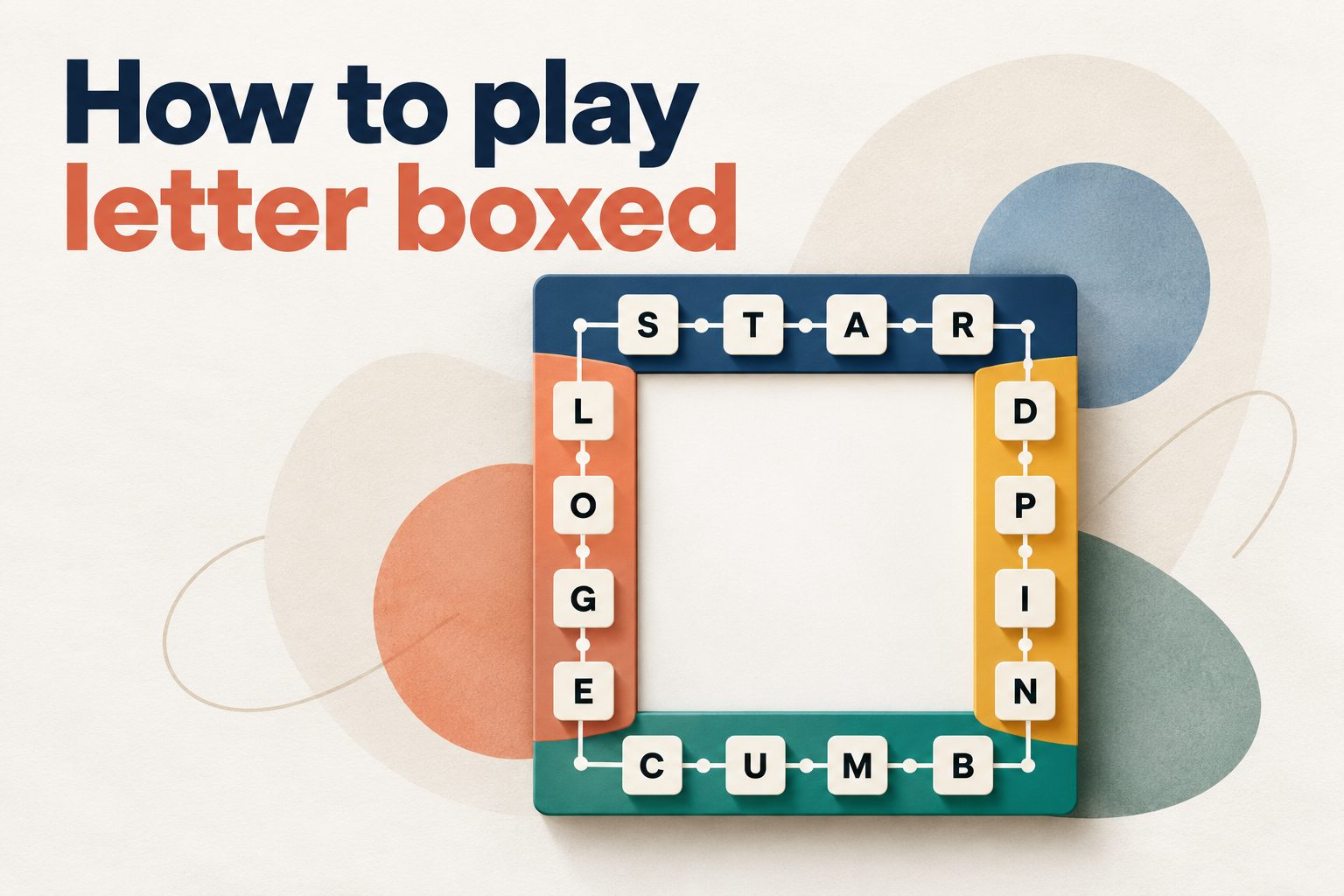
Learning how to play Letter Boxed is a satisfying way to build vocabulary, test pattern recognition, and enjoy a short daily word challenge. The puzzle looks simple at first: letters sit around the four sides of a square, and you make words by connecting them. The twist is that consecutive letters in any word cannot come from the same side.
Unlike many word games, Letter Boxed rewards planning as much as word knowledge. A valid-looking word may still be unusable if its letter path breaks the side-switching rule or if it leaves awkward letters for later. The goal is not simply to find many words; it is to solve the whole puzzle efficiently.
This guide explains the rules, a reliable solving process, useful examples, frequent mistakes, and practical strategies for getting better. Whether you are opening the puzzle for the first time or trying to reduce your word count, a few habits can make every board feel much clearer.
Letter Boxed is a word puzzle played on a square with three letters on each of its four sides. You form words by selecting letters in sequence from different sides of the box. A letter may be reused, but two consecutive letters may not come from the same side.
Your aim is to use every letter shown around the square. Each new word must begin with the final letter of the previous word, so the list of answers becomes one connected chain rather than a set of separate guesses.
The puzzle is usually solved with only a few words, although a longer solution can still be correct. Strong solutions balance familiar vocabulary with efficient coverage, especially when uncommon letters appear on difficult sides.
Because the board changes, there is no fixed list of winning words to memorize. What transfers from puzzle to puzzle is the ability to read side relationships, notice useful word endings, and keep the next starting letter in mind.
A calm, methodical approach works better than rushing. Treat the square as a map of legal letter transitions, then build words that cover letters while leaving flexible options for the next move.
How Do You Play Letter Boxed?
Read The Four Sides First
Before entering a word, look at all twelve letters and mentally group them by side. Notice vowels, common consonants, and unusual letters such as J, Q, X, or Z. This quick scan helps you see which letters may be hard to use and which side changes could create common word patterns.
Follow The Side-Switching Rule
Every adjacent pair of letters in a word must come from different sides of the square. If two letters appear on the same side, they cannot be selected one after another. You can return to a side later in the word, but only after choosing at least one letter from another side.
Make A Valid First Word
Choose a word that uses several letters and ends with a useful starting letter for another word. Do not worry about covering every letter immediately. A practical opening word often includes a vowel, avoids trapping difficult letters, and gives you a common final letter such as E, R, S, T, or N.
Carry Forward The Final Letter
After you submit a word, the next word must start with the previous word’s last letter. This is one of the most important rules in Letter Boxed. When considering a candidate word, always ask what it ends with and whether that ending gives you realistic options for the next word.
Track Letters You Have Covered
Watch which letters have turned active or been used as you play. This prevents you from spending several turns making attractive words that repeat the same easy letters. Give special attention to letters that appear only once and to letters whose side placement makes them difficult to connect naturally.
Use Words Of Different Lengths
Long words can cover a lot of ground, but short words are useful for repairing a chain or reaching one stubborn letter. A solution may need one broad opening word, a compact bridge word, and one final cleanup word. Flexibility matters more than trying to make every entry impressive.
Finish Only When Every Letter Is Used
The puzzle ends when all letters around the box have appeared in your word chain. Check the remaining unused letters before forcing a final entry. If only one or two letters remain, work backward from them and look for a word that begins with your required starting letter while containing the missing letters.
What Makes A Letter Boxed Word Valid
1. A word must be accepted as a standard dictionary word by the puzzle’s word list. Proper names, abbreviations, and many specialized terms are usually not accepted.
2. Consecutive letters must alternate between sides. It is legal to use letters from the same side in one word only when another side appears between them.
3. Letters can be used more than once. Reusing a vowel or common consonant is often necessary and does not reduce the validity of a solution.
4. The first word may start with any available letter. Every word after that must start with the last letter of the word immediately before it.
5. A word should use only letters displayed on the current square. You cannot introduce letters from outside the puzzle, even if they would make a familiar word.
6. A completed solution must include every displayed letter at least once. Repeated use of easy letters does not replace coverage of the remaining letters.
7. The fewest-word solution is a useful challenge, but a correct solution does not need to be minimal. First learn to finish consistently, then work on efficiency.
Why Letter Boxed Is Worth Playing
- Vocabulary Practice: The puzzle encourages you to recall word endings, prefixes, and less obvious everyday vocabulary without feeling like a formal study exercise.
- Flexible Thinking: A word that looks ideal may fail because of its side path, so you learn to change direction and consider alternatives quickly.
- Pattern Recognition: Repeated play helps you spot helpful transitions between sides and recognize letter combinations that may unlock longer words.
- Short Daily Challenge: A single board can fit into a brief break while still offering enough depth to reward careful thought and experimentation.
- Planning Skills: Each word affects the required beginning of the next one, which makes the puzzle a small but meaningful exercise in sequencing decisions.
- Low-Pressure Improvement: There is value in any completed solution, while lower word counts give experienced players a clear way to set harder personal goals.
- Conversation Starter: Comparing different valid solutions is interesting because two players can solve the same board with completely different word chains.
Best Strategies For Letter Boxed
Start With Difficult Letters
Look for the letters most likely to cause trouble before you commit to easy words. A rare consonant, an awkward vowel placement, or a letter surrounded by poor transitions can become a late-game obstacle. Try to include one difficult letter early, while the board still gives you many possible continuations.
Think In Side Pairs
Instead of seeing twelve separate letters, consider which sides work well together. If one side contains useful vowels and another contains common consonants, moving back and forth between them may produce several word fragments. This view makes legal paths easier to recognize than checking every letter individually.
Save Flexible Endings
An ending such as E, R, S, N, or T often gives you more choices for the following word than a highly restrictive ending. Before submitting a word, compare its final letter with the start letters available for your likely next moves. A slightly shorter word can be better if it preserves momentum.
Use Word Families Carefully
Word families can quickly suggest options: plural endings, common suffixes, verb forms, and familiar prefixes may all help. However, do not assume that a related word will follow the same legal path. Check each adjacent pair against the sides, because a single illegal transition invalidates the whole word.
Work Backward From Leftover Letters
When only a few letters remain, reverse the usual process. Ask which words contain the difficult leftover letter and which of those can begin with your current required letter. Then test whether their internal path alternates sides. Backward thinking is especially effective near the end of a board.
Avoid Chasing The Perfect First Word
A long opening word feels productive, but it can create an unusable final letter or leave several letters that do not combine well. Prefer a word that opens choices over one that merely uses many letters. A dependable two- or three-word finish is better than restarting repeatedly for a flashy opener.
Review The Chain Before Restarting
If you become stuck, inspect the last word and identify what caused the problem. Perhaps its final letter is too restrictive, or perhaps you ignored an awkward letter too long. Replace only the weak link when possible. This teaches more than clearing the whole attempt and starting without a plan.
Letter Boxed becomes much easier once you focus on its connected rules rather than treating it as a normal word list. Read the sides, alternate between them, carry the last letter forward, and keep every unused letter visible in your plan.
The best results come from balancing coverage with flexibility. Long words help, but a useful ending and a clear route to difficult letters are often more important than length alone.
With regular practice, side patterns and word families become easier to notice. Start by aiming for complete solutions, then gradually challenge yourself to finish the same kind of board in fewer words.
FAQs About Letter Boxed
Can You Reuse Letters In Letter Boxed?
Yes. You may use any displayed letter more than once, even within the same solution. Reuse is often necessary because the side-switching rule can make a direct path impossible. What matters is that every letter in a submitted word follows a legal route between different sides.
Do Words Have To Be Long In Letter Boxed?
No. Long words can be helpful because they cover more letters, but short words are completely valid and often essential. A short word can connect an awkward ending to a useful beginning, include a missing letter, or make the final cleanup step possible.
Why Is My Word Rejected In Letter Boxed?
A rejected word usually has an illegal pair of consecutive letters from the same side, contains a letter not on the board, or is not included in the puzzle’s accepted word list. Check the path letter by letter before assuming the vocabulary itself is the problem.
Must Each New Word Start With The Previous Ending?
Yes. After the first word, each new word must begin with the final letter of the word before it. This chaining rule is central to the puzzle because it turns word selection into planning. Always consider the ending of a candidate before submitting it.
How Many Words Should A Letter Boxed Solution Use?
There is no single required number of words for a valid solution. The main goal is to use every letter while following the rules. Fewer words are generally considered more efficient, but a four- or five-word solution is still a worthwhile result, especially for newer players.
What Is The Best Way To Improve At Letter Boxed?
Practice scanning the square by side, not just by individual letter. Learn to notice useful endings, include difficult letters early, and review why a chain became stuck. Over time, you will recognize more legal patterns and make stronger choices without needing to guess as often.